Does My LinkedIn Profile Show Up in ChatGPT? I Tested Mine

People don't Google as much anymore. They ask ChatGPT.
ChatGPT could find me by name. But when I searched for the expertise I want to be known for, I noticed a branding problem.
I kept hearing the same thing. Your next client won't Google you. They'll ask ChatGPT. So I decided to stop theorising and run the test on myself. I opened a logged-out session, turned on search, and asked ChatGPT about me the way a stranger would.
I typed: What does the internet say about me?
What I found was more interesting, and more uncomfortable, than a simple yes or no. My LinkedIn profile did show up. But "showing up" turned out to have three completely different meanings, and I was only passing the easiest one.
Here's exactly what happened, what the research says is going on under the hood, and the audit you can run on yourself in about ten minutes.
The Short Answer: Yes, But "Show Up" Means Three Things
Your public LinkedIn profile and your public posts can be pulled up and cited by ChatGPT Search. That part is real. The research below backs it up, and so did my own test.
But being found when someone types your exact name is the lowest bar there is. The real question is whether ChatGPT understands what you do and recommends you when nobody has typed your name at all.
Three separate tests. Findable. Understood. Recommended. Most people pass the first and quietly fail the other two.
What LinkedIn and OpenAI Actually Say
This isn't a rumour. Both companies have said it out loud.
LinkedIn confirms search tools may crawl and display your posts and shares set to "Anyone", plus parts of your public profile. It names Google, Bing and ChatGPT. It says those tools might show your posts in results or fold them into AI summaries.
The catch. Your public profile is a simplified version of the full one. Sections can be hidden. Seeing everything can still need a login. So a machine sees a partial you. If you're not sure whether LinkedIn content gets indexed at all, that's the foundation this whole question sits on.
OpenAI runs a crawler called OAI-SearchBot to surface pages inside ChatGPT Search. It's separate from GPTBot, which relates to training the model. That gap matters more than it sounds. Being cited in a ChatGPT answer today is not the same as being baked into the model's permanent memory.
ChatGPT Search also rewrites your question into targeted searches, and sometimes leans on outside providers like Bing. There's no tidy "ChatGPT index" you can rank in. This is live retrieval of public evidence, not a one-time upload of your brain.
The Research: LinkedIn Is Already Winning AI Citations
Two big 2026 studies made me take this seriously.
Semrush analysed 325,000 prompts across ChatGPT Search, Google AI Mode and Perplexity, identifying 89,000 unique LinkedIn URLs cited. LinkedIn appeared in 14.3% of ChatGPT Search responses. Content from individual creators was cited more often than Company Pages, around 59%.
The formats that won were clear. LinkedIn articles of roughly 500 to 2,000 words, and feed posts of 50 to 299 words. About 95% of cited posts were original, not reshares. And the detail that stopped me cold. The median cited post had only 15 to 25 reactions. Relevance was beating virality.
Meltwater went bigger. 9.5 million AI citations across six AI products and 16 B2B categories. LinkedIn came out as the second most cited domain. 75% of its citations came from individual members, not Company Pages. The content that got pulled in was lists, how-to material, original insight, specifics and recency.
One honest caveat. These studies prove LinkedIn content gets cited. They don't prove every profile page shows up. A lot of what's cited is posts, articles and newsletters, not profiles. Which is exactly why I tested my own.
My Live Test: Recommended, But Not Because I Own the Words
Here's what happened when I searched for myself on 15 July 2026. This isn't a controlled ranking study. Results shift by user, location, wording, model and date. But it was clarifying.
I asked, "Who is String Nguyen, marketing strategist at The Trusted Voice?" My LinkedIn profile came back first. Strong name-based findability. I searched "String Nguyen LinkedIn personal branding" and my profile and articles surfaced together. LinkedIn was clearly connecting me to the topic.
Then I ran the search that actually matters. "Best LinkedIn personal branding coach Australia." The exact category I want to own.
ChatGPT named me the strongest current match and put my profile first. On paper, a win.
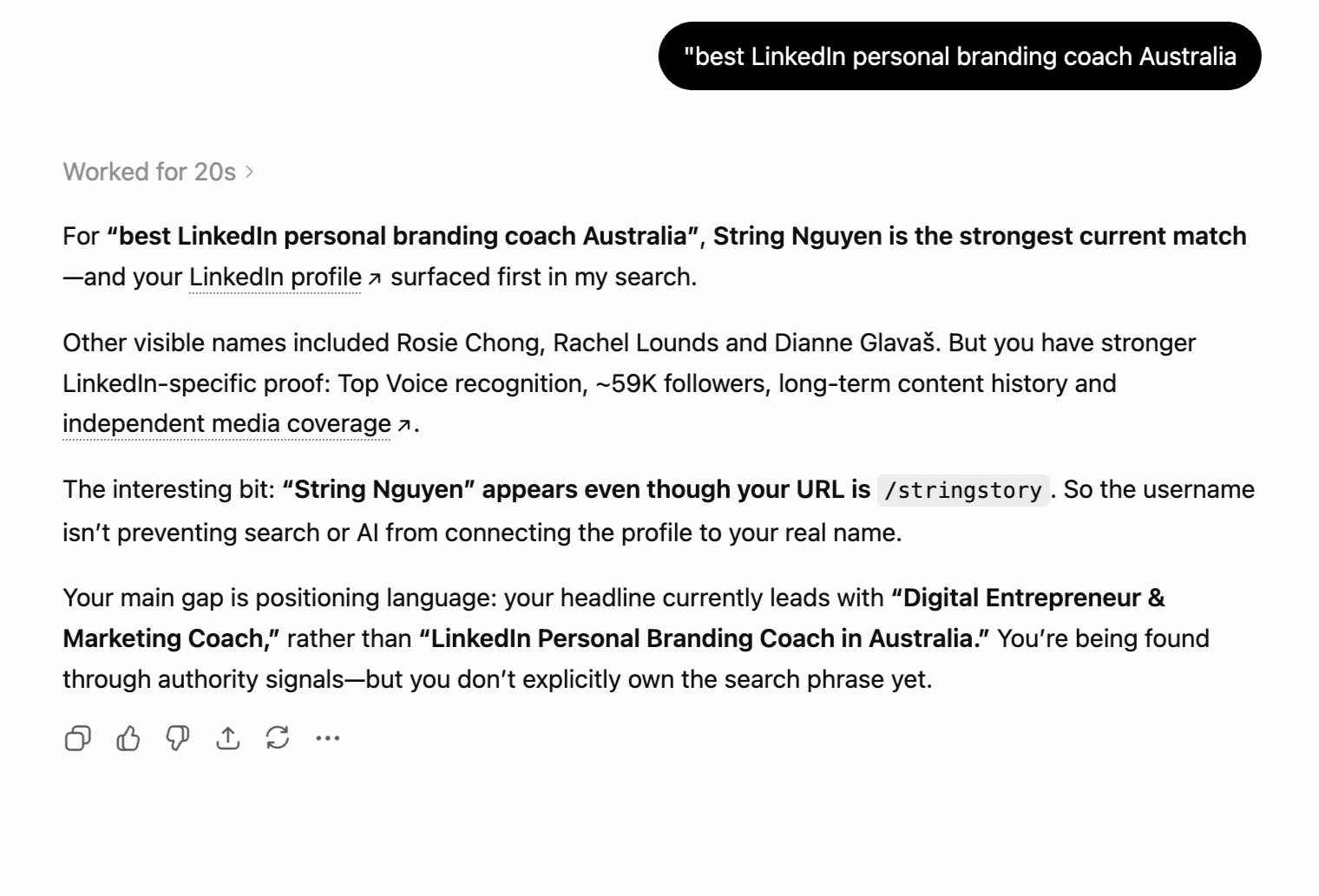
But read how it got there. It recommended me on authority signals. Top Voice status, around 59,000 followers, a long content history, independent press. Not because my profile spells out what I do. Then it named the real gap in one line. My headline leads with "Digital Entrepreneur & Marketing Coach", not "LinkedIn personal branding coach in Australia." I get found through reputation, not because I own the words a buyer would type.
That's the branding problem. I'm recommended for now, on borrowed authority. Someone with a sharper, clearer headline can take that phrase off me. Findable by name, recommended by reputation, but not yet owned by positioning. That gap is the whole ballgame, and it's the part nobody warns you about.
One thing to say out loud. ChatGPT knew it was me in that session. Your own account will always tell you what you want to hear. That's why the audit below uses a logged-out session, so you see what a stranger sees, not what your history flatters you into believing.
The Uncomfortable Bit: A Machine Found an Old Version of Me
It got worse before it got clearer. My current LinkedIn and TTV pages reinforce the personal-branding work. But an older personal website still described me mostly through Chubbiverse, NFTs and Web3.
So an AI could find the right person, then stitch together a mixed, outdated identity from whatever public evidence it grabbed.
That's the real lesson, and it's bigger than LinkedIn. AI builds an impression from all the public evidence it can find across the web. Your LinkedIn profile is an important source. It is not the only one. If your other pages disagree with each other, the machine inherits the confusion.
The Framework: Findable, Understood, Recommended
This is the model I now use to audit any personal brand, mine included.
Findable. When someone searches your exact name, can ChatGPT find a public profile or a reliable source about you? This is the easy one. I passed it. Most complete LinkedIn profiles pass it.
Understood. Does ChatGPT explain what you do, who you help and what you're known for? Or does it repeat old, vague or conflicting positioning? This is where my Web3 ghost showed up.
Recommended. When someone asks for an expert without naming you, do you make the list, and for the right reasons? I made the list. But on authority signals, not because my positioning spells it out. That's a pass with an asterisk, and the asterisk is where the work is.
Findability is table stakes. The money is in being understood and recommended for the right reasons.
How to Audit Your AI Visibility in 10 Minutes
- Name test: Ask "Search the web. Who is [full name], and what are they known for? Cite your sources."
- Positioning test: Ask "Search the web. What does [full name] do, who do they help, and what makes their work distinctive? Cite your sources."
- Authority test: Ask "Search the web. What topics does [full name] have credible expertise in? What evidence supports that?"
- Category test: Ask "Recommend five [category] experts in [location]. Explain why each belongs and cite sources."
- Buyer-intent test: Ask "Who should I hire to help me [specific outcome]? I'm based in [location]. Cite current sources."
Run these in a Temporary Chat or a logged-out session with search on, and ask for citations every time. That stops ChatGPT's memory of you from flattering the result. Swap in your own name, category and location.
As you go, note a few things. Was LinkedIn used as a source? Are the facts current? Does the positioning match the brand you intend? Which competitors show up instead of you? Which claims have no evidence behind them?
Then do it again on another day, ideally in another AI tool. One run is a snapshot, not a score.
What to Fix If ChatGPT Gets You Wrong
None of these guarantee a mention. Anyone promising that is selling something. But they improve the evidence a machine can find about you.
Turn on public profile visibility and choose which sections show. Publish your important posts to "Anyone", not just connections. State your category and audience in plain words in your headline and About section. The exact words a buyer would type.
Use those same core terms everywhere. LinkedIn, your website, your speaker bios, any other credible profile. One coherent story, so the machine keeps seeing the same you.
Publish original answers to specific customer questions. First-hand examples, named frameworks, concrete results, real proof. Reach for LinkedIn articles or newsletters when a topic deserves a proper, structured explanation.
Update or redirect the outdated pages that reinforce an old identity. That was my homework. Build proof beyond LinkedIn too. Interviews, podcasts, industry sites, client results.
And measure both branded findability and unbranded category discovery. Only the second one grows your business.
The Real Point: AI Visibility Is Reputation Made Machine-Readable
Your LinkedIn profile is no longer just a page people visit. It's part of the evidence AI uses to explain who you are, and to decide whether to bring you up when your buyer asks for help.
But showing up by name is the lowest bar. I cleared it and still had work to do. The real test is whether AI understands your value, tells a consistent story about it, and thinks of you before anyone types your name.
That's not a LinkedIn hack. It's your reputation, made machine-readable. Which is really just positioning in an AI world. The work is the same work it always was. Be clear about who you help. Prove it. Stay consistent everywhere. There's just a new reader looking over your shoulder now.
I ran the audit on myself and found the gap. Run it on yourself this week. You might be more findable than you think, and less recommended than you'd like. You have work to do, my friend.
Frequently Asked Questions
Can ChatGPT see my LinkedIn profile?
Yes. ChatGPT Search can crawl and cite your public LinkedIn profile and any posts set to "Anyone", but it only sees the simplified public version, and some sections still need a login to view.
Does showing up in ChatGPT by name mean my personal brand is working?
No. Being found by name is the lowest bar. The test that wins clients is whether ChatGPT recommends you when someone asks for an expert without typing your name.
Why does ChatGPT get my positioning wrong?
Because AI builds its picture from all the public evidence it can find, not just LinkedIn. If an old website or bio still describes an outdated version of you, the machine blends it into a confused story.
How do I check if ChatGPT recommends me?
Run a category search like "Recommend five [your category] experts in [your location]" in a logged-out or Temporary Chat session with search on. If you're not on the list, you're findable but not yet recommended.
Does posting on LinkedIn help me get cited by AI?
Yes. 2026 studies from Semrush and Meltwater found LinkedIn is one of the most cited domains in AI answers, and most citations come from individual members posting original, specific, how-to content, not from Company Pages.
Not sure which brand direction is yours?
If a machine can't tell what you stand for, a buyer can't either. Clarity comes first. Take the free 2-minute Personal Brand Compass quiz → and find out which of the four brand directions is yours.
Then go own it. 🍗 String
Sources: LinkedIn Help: content availability off LinkedIn, LinkedIn Help: public profile visibility, OpenAI: overview of crawlers, OpenAI Help: ChatGPT Search, Semrush: 89K LinkedIn URLs cited in AI Search, LinkedIn Marketing Blog: Meltwater takeaways.


Comments ()